
Did You Know Your Brain May React to ASMR Like Real-Life Social Bonding?
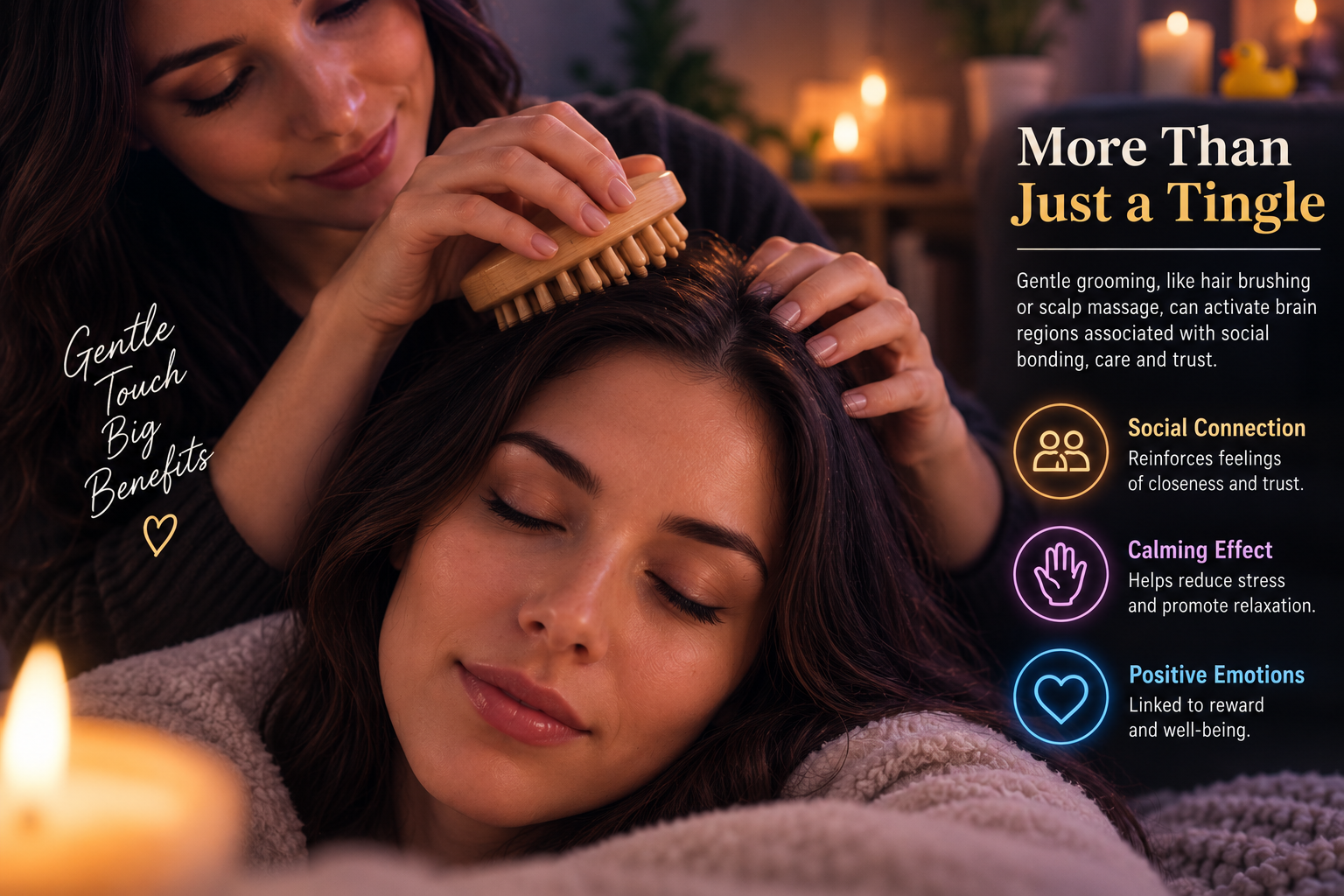
That relaxing feeling you get when someone whispers to you, brushes your hair, or gives you careful personal attention in an ASMR video may be doing more than simply producing tingles. Brain-imaging research suggests that ASMR activates some of the same brain regions associated with social connection, grooming, reward, and affiliative behavior.
In other words, even though you know you’re watching a video, parts of your brain may respond in ways that resemble a comforting real-life social interaction.

Why Does Personal Attention ASMR Feel So Comforting?
Think about some of the most popular ASMR scenarios: someone gently examining your eyes, brushing your hair, giving you a scalp massage, performing a cranial nerve exam, or quietly reassuring you.
There’s something these triggers have in common. They imitate close, safe, one-on-one interactions.
Many of these experiences resemble behaviors humans normally associate with care and social connection. A haircut, massage, medical examination, or someone gently playing with your hair involves another person focusing their attention entirely on you.
ASMR videos recreate many of those cues through direct eye contact, soft speech, close camera positioning, slow movements, and simulated touch.
Scientists Have Actually Watched the Brain Experience ASMR
In a fascinating 2018 study, researchers placed people who experience ASMR inside an fMRI scanner while they watched ASMR videos.
Participants indicated when they were experiencing relaxation and when they were experiencing actual ASMR tingles. This allowed researchers to examine which areas of the brain became more active during the experience.
Among the regions showing significant activation were the medial prefrontal cortex (mPFC) and the nucleus accumbens.
Why is that interesting?
The nucleus accumbens is heavily involved in reward and pleasurable experiences, while the medial prefrontal cortex participates in social cognition, self-awareness, and social behaviors.

ASMR and Grooming May Have Something in Common
One particularly intriguing part of the research is the connection with grooming and affiliative behaviors.
Grooming isn’t just about keeping clean. In humans and other social animals, gentle touch, hair grooming, caressing, and similar behaviors can reinforce relationships and communicate safety, trust, and affection.
Researchers behind the 2018 brain-imaging study noted that activation observed during ASMR showed similarities to neural patterns associated with affiliative behaviors.
That makes classic ASMR triggers such as hair brushing, scalp massages, face touching, and gentle personal attention especially interesting.

Your Brain Knows It’s a Video… So Why Can It Feel Personal?
Logically, you know that an ASMR creator isn’t actually examining your eyes or touching your face.
But your brain is receiving many of the sensory and social cues that would accompany the real experience.
The creator looks directly into the camera. They speak quietly to “you.” Their hands move toward your face. Binaural audio can make a whisper appear to come from directly beside your ear.
Together, those cues can create a convincing simulation of another person’s presence.
Did you know? ASMR is usually experienced alone, yet many of its most powerful triggers imitate intimate social interactions involving care, attention, and trust.
Personal-Attention Roleplays Suddenly Make a Lot of Sense
This may help explain why personal-attention roleplays are such a huge part of ASMR.
Consider some familiar ASMR scenarios:
- Cranial nerve examinations
- Eye examinations
- Haircuts and hair brushing
- Scalp massages
- Facials and spa treatments
- Makeup application
- Medical examinations
- Whispered reassurance
The sounds certainly matter, but these videos contain something that a simple recording of tapping doesn’t: simulated human interaction.
The viewer isn’t simply hearing relaxing sounds. They’re being placed at the center of an interaction.

What About Oxytocin, the “Bonding Hormone”?
This is where things get especially interesting, but also where we need to distinguish between what scientists have observed and what they have only hypothesized.
Oxytocin is involved in many forms of human social behavior and bonding. Positive interpersonal interactions and social touch can involve oxytocin signaling, and some of the brain regions activated during ASMR overlap with regions associated with these affiliative experiences.
Researchers have therefore proposed that neurochemicals involved in social bonding, including oxytocin, dopamine, and endorphins, could contribute to ASMR’s characteristic feelings of comfort and relaxation.
However, there is currently no solid evidence showing that ASMR itself causes a specific release of oxytocin. That idea remains a scientific hypothesis rather than an established fact.
ASMR Seems to Combine Relaxation and Reward
Another unusual feature of ASMR is that the experience appears to combine two states that might seem contradictory.
You can feel deeply relaxed while simultaneously experiencing pleasurable excitement from the tingles.
Physiological research supports this unusual combination. In a 2018 study, people experiencing ASMR showed lower heart rates alongside increased skin conductance. The researchers interpreted this as evidence that ASMR can simultaneously produce calming and arousing responses.
Combined with evidence of activity in reward and emotion-related brain regions, this helps explain why ASMR can feel relaxing without simply making you feel bored or sleepy.
Is ASMR Basically a Virtual Hug?
Not exactly, but it’s a useful way of thinking about what researchers are discovering.
ASMR cannot replace genuine human relationships, physical affection, or social interaction. But certain ASMR experiences appear capable of reproducing some of the sensory and social signals associated with being cared for by another person.
This could be one reason a quiet personal-attention video can feel strangely comforting, even when you’re sitting completely alone with headphones on.
Your conscious mind knows you’re watching a screen.
Parts of your brain may nevertheless be responding to the whispering, eye contact, gentle movements, and simulated touch as meaningful social cues.
Final Thoughts
ASMR research is still relatively young, and scientists have much more to discover about exactly why the experience occurs.
But brain-imaging studies have revealed an intriguing clue: ASMR appears to engage brain systems involved in reward, emotion, sensation, and social behavior. Some of that activity resembles what researchers see during positive affiliative experiences such as social bonding and grooming.
So the next time an ASMR creator whispers to you, carefully examines your eyes, or pretends to massage your scalp, the relaxing feeling may involve much more than the sound itself.
Your brain may be responding to the experience as something surprisingly social.
Sources and References
-
Lochte, B. C., Guillory, S. A., Richard, C. A. H., & Kelley, W. M. (2018).
An fMRI investigation of the neural correlates underlying the autonomous sensory meridian response (ASMR).
BioImpacts, 8(4), 295–304.
Read the study
-
Smith, S. D., Fredborg, B. K., & Kornelsen, J. (2019).
A functional magnetic resonance imaging investigation of the autonomous sensory meridian response.
PeerJ.
Read the study
-
Poerio, G. L., Blakey, E., Hostler, T. J., & Veltri, T. (2018).
More than a feeling: Autonomous sensory meridian response (ASMR) is characterized by reliable changes in affect and physiology.
PLOS ONE.
Read the study
-
Fredborg, B. K., Smith, S. D., & Kornelsen, J. (2016).
An examination of the default mode network in individuals with autonomous sensory meridian response (ASMR).
Social Neuroscience.
View the study