
Did You Know That ASMR Can Be Triggered by More Than Just Sound?
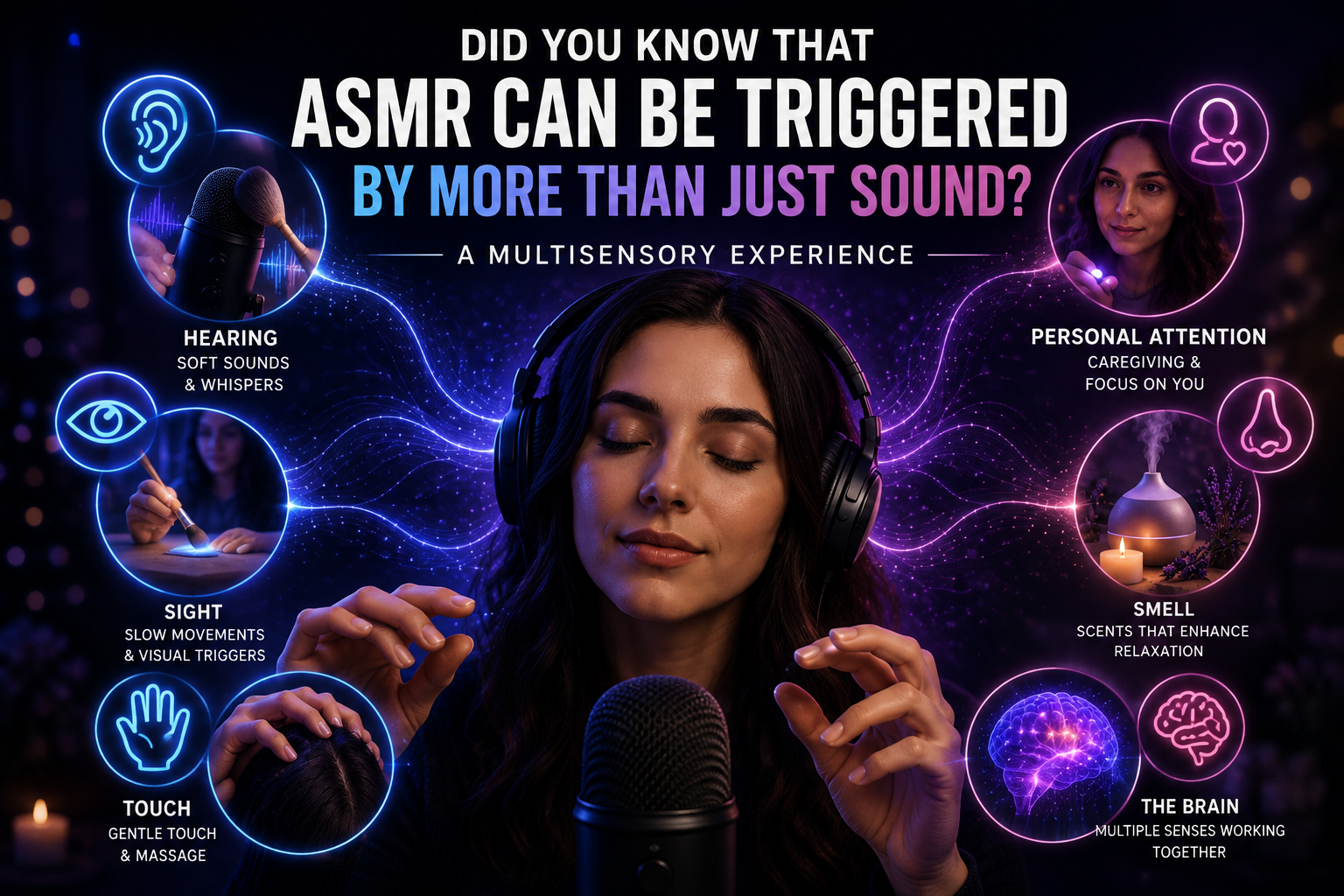
When most people think of ASMR, they imagine whispering, tapping, or gentle scratching sounds. While these are among the most common triggers, science has shown that ASMR is actually a multisensory experience. Depending on the person, it can be triggered by sight, touch, movement, personal attention, and sometimes even smell.

ASMR Is More Than an Auditory Experience
Although the majority of ASMR videos focus on sound, researchers have found that the tingling sensation is not limited to hearing. Instead, ASMR appears to involve multiple areas of the brain responsible for processing sensory information and emotions.
This is one reason why two people can watch the exact same ASMR video and have completely different experiences. One person may respond to the whispering, while another experiences tingles from slow hand movements or gentle eye contact.
👂 Hearing: The Most Common Trigger
Hearing is undoubtedly the sense most commonly associated with ASMR. Soft whispers, tapping, page turning, crinkling, brushing, typing, water sounds, and gentle mouth sounds are among the most popular triggers.
These sounds are typically quiet, repetitive, and predictable, which may help the brain enter a deeply relaxed state.

👀 Vision: Watching Can Be Just as Powerful
Many people experience ASMR simply by watching slow, careful movements. This is often called visual ASMR.
Common visual triggers include:
- Slow hand movements
- Hair brushing
- Drawing or painting
- Folding towels
- Organizing objects
- Medical examinations
- Cranial nerve exams
Even with the sound turned off, these visual cues can create relaxation and, for some people, the famous tingles.

✋ Touch: The Original ASMR Trigger
Long before ASMR videos became popular, many people first experienced ASMR during real-life interactions.
Gentle haircuts, scalp massages, facials, eye examinations, makeup application, and even someone tracing a finger lightly across the skin are all examples of tactile triggers.
While videos cannot physically recreate these sensations, they often simulate them through careful visuals and immersive audio.

❤️ Personal Attention: A Powerful Combination
One of the strongest ASMR triggers is not actually a single sense—it is the feeling of receiving someone’s full attention.
This explains why roleplays such as medical exams, spa treatments, eye tests, or makeup sessions are so popular. These experiences combine eye contact, soft voices, slow movements, and the illusion that someone is caring exclusively for you.
Researchers believe this combination of sensory cues may activate brain networks involved in trust, comfort, and social bonding.
👃 Can Smell Trigger ASMR?
Smell is one of the least studied ASMR triggers, but many people report that certain scents contribute to a relaxing ASMR experience.
Fresh rain, candles, essential oils, coffee, lavender, or a favorite perfume may not directly produce tingles, but they can enhance relaxation and create the perfect environment for ASMR.
Because smell is closely connected to memory and emotion, researchers believe it may indirectly strengthen the ASMR experience for some individuals.
🧠 The Brain Combines All These Signals
Scientists now believe ASMR is best understood as a multisensory experience. Rather than one sense acting alone, the brain combines information from hearing, vision, touch, and emotional context to produce feelings of relaxation and, for some people, tingles.
This also explains why everyone’s triggers are unique. Your brain may respond strongly to whispering, while someone else experiences ASMR only during a haircut or while watching careful hand movements.

Final Thoughts
ASMR is far more than a collection of relaxing sounds. It is a fascinating sensory experience that can involve hearing, vision, touch, personal attention, and even smell. As researchers continue studying the brain, we’re learning that the famous ASMR tingles result from the way multiple senses work together—not just one.
So the next time you watch an ASMR video, pay attention to what affects you the most. You may discover that your strongest trigger isn’t a sound at all.
Discover Your Personal ASMR Triggers
Everyone experiences ASMR differently. Explore different types of ASMR content—from whispering and tapping to immersive cranial nerve exams and scalp massages—to find the triggers that work best for you.
Sources and References
-
Barratt, E. L., & Davis, N. J. (2015). Autonomous Sensory Meridian Response (ASMR): A flow-like mental state. PeerJ.
https://peerj.com/articles/851/
-
Poerio, G. L., Blakey, E., Hostler, T., & Veltri, T. (2018). More than a feeling: ASMR is characterized by reliable changes in affect and physiology. PLOS ONE.
https://journals.plos.org/plosone/article?id=10.1371/journal.pone.0196645
-
Smith, S. D., Fredborg, B. K., & Kornelsen, J. (2017). An examination of the default mode network in individuals with ASMR. Social Neuroscience.
https://pubmed.ncbi.nlm.nih.gov/26818688/