
Did You Know Only About 20% of People Experience ASMR?
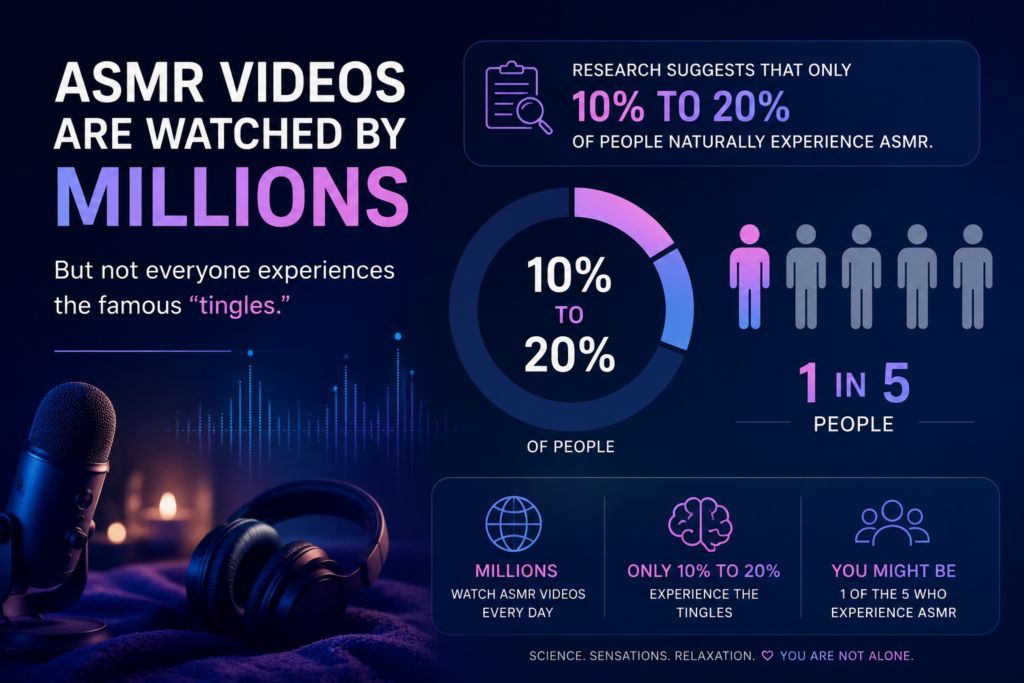
ASMR videos are watched by millions of people around the world, but not everyone experiences the famous “tingles.” Research suggests that only about 10% to 20% of people naturally experience ASMR, with some studies estimating the number at around 1 in 5 people.
What Is ASMR?
ASMR stands for Autonomous Sensory Meridian Response. It is usually described as a pleasant tingling sensation that starts around the scalp and can move down the neck, shoulders, and spine.
Common ASMR triggers include whispering, tapping, scratching, soft speaking, personal attention, hair brushing, and slow hand movements. For people who experience ASMR, these triggers can create a deep feeling of relaxation, comfort, and calm.
How Many People Experience ASMR?
The exact number is still being studied, but current estimates suggest that around 10% to 20% of the population experiences ASMR. A 2022 study suggested a prevalence rate of approximately 20%, which means about 1 in 5 people may experience ASMR tingles.
Did you know? If you experience ASMR tingles, you are likely part of a minority of people who naturally respond to ASMR triggers.
How Do Researchers Study ASMR?
Since ASMR is a personal sensory experience, researchers usually study it through a combination of surveys, self-reports, video experiments, and physiological measurements.
In one well-known study, researchers found that people who experience ASMR showed measurable physical changes while watching ASMR videos. These included a reduced heart rate, which is associated with relaxation, and increased skin conductance, which suggests emotional engagement.
This is one of the reasons ASMR is so fascinating: it appears to be both calming and emotionally stimulating at the same time.
Why Do Some People Experience ASMR and Others Don’t?
Scientists do not yet have a complete answer. One theory is that people who experience ASMR may process sensory and emotional information differently. Some studies have also explored possible links between ASMR, personality traits, and sensory sensitivity.
Research has suggested that ASMR may be more common in people who score higher in traits such as openness to experience. Other studies have also explored connections between ASMR and synesthesia, another unusual sensory experience where senses can overlap.
Do You Need Tingles to Enjoy ASMR?
No. Even if someone does not experience the classic tingling sensation, they may still enjoy ASMR content. Many viewers use ASMR videos to relax, focus, reduce stress, or fall asleep.
This means ASMR can still be useful and enjoyable even for people who do not feel tingles. The relaxing atmosphere, gentle sounds, and slow pacing can create a calming experience on their own.
Why This Makes ASMR So Interesting
ASMR is still a young area of scientific research, but it has already shown that online relaxation content can have real effects on the body and mind. The fact that only a portion of people experience ASMR makes it even more mysterious.
For those who do feel it, ASMR can be a powerful and comforting sensory response. For those who don’t, it can still be a peaceful way to unwind.
Final Thoughts
Only about 10% to 20% of people are estimated to experience ASMR, with some research suggesting that roughly 1 in 5 people naturally respond to ASMR triggers.
So, if whispering, tapping, scalp massages, or gentle personal attention give you relaxing tingles, you may be part of a unique group of people who experience ASMR in a measurable and scientifically interesting way.
Want to Test Your ASMR Response?
Try watching different types of ASMR videos, such as whispering, tapping, scalp massage, hair brushing, or personal attention. Everyone’s triggers are different, and sometimes it takes a few tries to discover what works best for you.
What do you think?
Have you experienced ASMR tingles? Join the discussion in the comments of my latest YouTube video or reply to my monthly newsletter. I’d love to hear your experience!
Sources and References
- Poerio, G. L. et al. (2022). Similar but different: High prevalence of synesthesia in autonomous sensory meridian response (ASMR). This study suggested an ASMR prevalence rate of approximately 20%.
https://pmc.ncbi.nlm.nih.gov/articles/PMC9558233/ - Poerio, G. L. et al. (2018). More than a feeling: Autonomous sensory meridian response (ASMR) is characterized by reliable changes in affect and physiology. PLOS ONE. This study found that ASMR was associated with reduced heart rate and increased skin conductance.
https://journals.plos.org/plosone/article?id=10.1371/journal.pone.0196645 - Cleveland Clinic. (2025). ASMR Explained: Triggers and Types. This article summarizes common ASMR triggers and notes that an estimated 10% to 20% of people experience ASMR.
https://health.clevelandclinic.org/what-is-asmr - UCLA Health. Large portion of population may feel ASMR benefits. This article explains the estimated 20% response rate and describes common ASMR sensations.
https://www.uclahealth.org/news/article/large-portion-population-may-feel-asmr-benefits